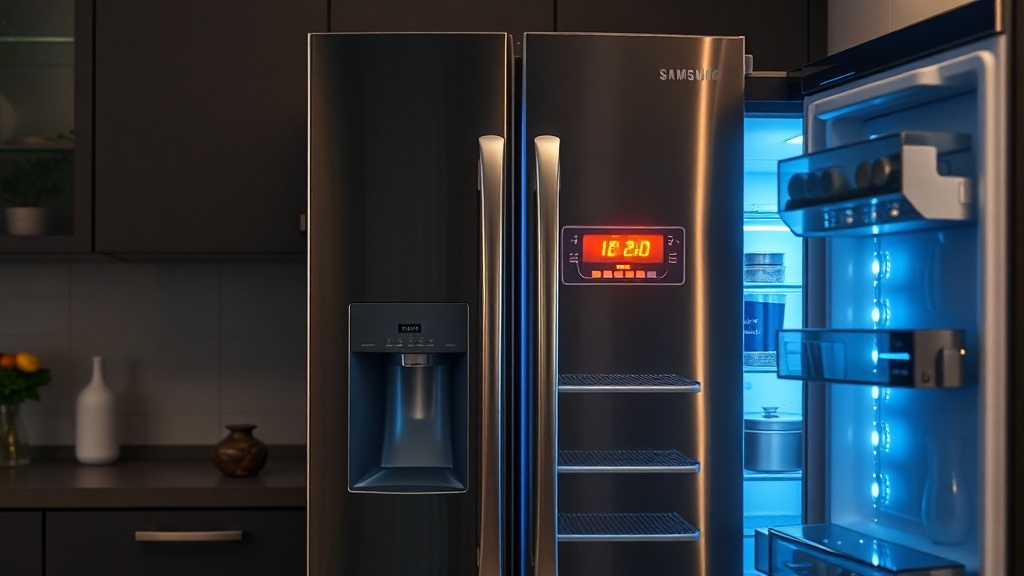
Why Samsung Refrigerator Error Codes Matter — and How DIY Resets Save You Money
Samsung refrigerator error codes are alphanumeric fault signals displayed on the control panel to identify specific system failures; a targeted DIY reset procedure can resolve the majority of these faults in under five minutes, avoiding unnecessary service charges.
Modern Samsung refrigerators are engineered with sophisticated onboard diagnostics. When a sensor detects an out-of-range condition — whether a temperature deviation, a defrost cycle failure, or a communication error between control boards — the unit immediately logs a fault code, a standardized alphanumeric string that pinpoints the subsystem at fault. Understanding these codes is not merely convenient; it is the first line of defense against food spoilage and premature compressor failure.
According to industry data, the average appliance repair call costs between $150 and $400 before parts. For a large portion of Samsung refrigerator complaints, the root cause is a soft electronic fault — a temporary sensor miscommunication or a control board latch-up — that a properly executed power cycle or diagnostic reset will permanently resolve. This is the core value proposition behind reliable Samsung refrigerator reset procedures: structured, code-specific intervention rather than guesswork.
The Most Common Samsung Refrigerator Error Codes and Their Root Causes
The most frequently encountered Samsung refrigerator error codes — including 5E, 8E, 22E, 24E, 33E, 40E, and PC ER — each map to a distinct subsystem failure, from defrost sensors to ice maker fans and communication line faults.
As an EPA Section 608 Universal-certified technician with hands-on experience across residential and commercial refrigeration platforms, I classify Samsung fault codes into three primary categories: thermal/sensor faults, mechanical/motor faults, and communication faults. Each category demands a different reset strategy.
| Error Code | Subsystem | Root Cause | DIY Reset Method | Professional Required? |
|---|---|---|---|---|
| 5E / SE | Freezer Defrost Sensor | Defrost sensor open circuit or ice bridging | Power cycle 5 min; manual defrost | Only if sensor fails ohm test |
| 8E | Ice Maker Sensor | Ice maker temperature sensor fault | Hard reset via breaker; test sensor resistance | If resistance out of spec |
| 22E | Fridge Fan Motor | Evaporator fan motor stall or open winding | Clear ice blockage; power cycle | Motor replacement if stalled |
| 24E | Fridge Defrost Sensor | Defrost heater circuit open; sensor failure | Manual defrost mode; inspect heater continuity | If heater element burned |
| 33E | Ice Pipe Heater | Ice supply tube heater open or shorted | Inspect wiring harness; power cycle | Heater replacement typically needed |
| 40E / 41E | Ice Room Fan | Ice maker fan motor stall | Clear obstructions; perform hard reset | Fan motor replacement if persistent |
| PC ER | Control Board Communication | Main PCB to sub-board communication failure | Reseat wiring harness; full power cycle | Board replacement if wiring is intact |
Step-by-Step Samsung Refrigerator DIY Reset Procedures
A proper Samsung refrigerator DIY reset always begins with a controlled power cycle — disconnecting the unit from mains power for a minimum of five minutes — which clears volatile fault memory in the main control board without risking data corruption.
The following procedures represent the industry-standard approach for each fault category. Always confirm the unit is unplugged before accessing any internal components, and never attempt to handle refrigerant lines without the appropriate EPA certification.
Procedure 1: The Universal Hard Reset (All Error Codes)
This is the correct first step for every fault code regardless of category. Unplug the refrigerator from its wall outlet or switch off the dedicated circuit breaker. Wait a full five minutes — not thirty seconds — to allow capacitors on the control board to fully discharge and the microcontroller’s non-volatile fault flags to reset. Restore power and observe the display. If the code clears and temperatures stabilize within two hours, the fault was a transient electronic latch-up.
Procedure 2: Manual Defrost Mode for Thermal Fault Codes (5E, 24E)
Thermal fault codes frequently arise from ice accumulation blocking the defrost sensor from accurately reading evaporator temperature. On most Samsung French door and side-by-side models, you can force a manual defrost cycle by simultaneously pressing and holding the Fridge and Energy Saver buttons for approximately eight seconds until “Fd” appears on the display. Allow the full defrost cycle to complete (approximately 20–30 minutes). This melts any bridging ice and allows the sensor to re-establish a clean baseline reading.
Procedure 3: Ice Maker Reset (8E, 33E, 40E, 41E)
Ice maker-related fault codes respond well to a dedicated ice maker reset. Locate the test/reset button on the ice maker module itself — typically a small rectangular button on the side of the ice maker assembly. Press and hold for three seconds until you hear the ice maker motor cycle. This re-initializes the ice maker’s internal microcontroller independently of the main board. Combine this with a full hard reset for persistent codes.
Procedure 4: Communication Fault Reset (PC ER)
The PC ER code indicates that the main control board has lost communication with a secondary board, most commonly the display board or the freezer sub-board. Before assuming board failure, physically inspect the wiring harness connectors between both boards. Unplug and firmly reseat each connector. Corrosion or a partially dislodged connector tab is the culprit in a significant percentage of PC ER complaints. After reseating, perform a hard reset to clear the fault register.
When a DIY Reset Is Not Enough: Refrigerant-Side Failures
Error codes indicating compressor overload, abnormally high or low cabinet temperatures despite a successful reset, or any audible clicking from the compressor relay signal a refrigerant-circuit fault that legally requires an EPA Section 608 certified technician to diagnose and repair.
This is the boundary that separates a legitimate DIY repair from a federally regulated service procedure. Under EPA Section 608 of the Clean Air Act, it is illegal for an uncertified individual to purchase regulated refrigerants, including hydrofluorocarbons (HFCs) such as R-134a commonly used in Samsung domestic refrigerators, or to perform any service that knowingly releases refrigerant into the atmosphere. The penalty for violations can reach $44,539 per day per violation.
“Venting or releasing refrigerants covered under Section 608 is prohibited. Technicians servicing this equipment must be certified under 40 CFR Part 82, Subpart F.”
— U.S. Environmental Protection Agency, Section 608 Regulatory Overview
The EPA Section 608 Universal Certification — the credential I hold — requires passing a Core examination plus three equipment-type examinations. Type I specifically covers small appliances containing five pounds or less of refrigerant, which encompasses virtually all domestic Samsung refrigerators. Type II covers high-pressure systems including residential split systems and commercial refrigeration racks, while Type III addresses low-pressure systems such as large industrial centrifugal chillers. Earning the Universal designation means demonstrating competency across all three equipment classes, plus the Core section governing environmental law, safety, and refrigerant shipping regulations. Critically, unlike most professional licenses, this certification carries no expiration date — it remains valid for the lifetime of the holder.
Preventive Maintenance to Prevent Error Codes From Recurring
Eighty percent of recurring Samsung refrigerator fault codes can be prevented through three maintenance actions: cleaning condenser coils every six months, inspecting door gaskets quarterly, and ensuring adequate clearance around the cabinet for airflow.
Dirty condenser coils are the single most common cause of thermal fault codes and compressor overload conditions. When coil surfaces are coated with dust and pet hair, the refrigerant cannot efficiently reject heat, causing condensing pressure to spike. This elevated pressure forces the compressor to work harder and run hotter, eventually triggering thermal protection and fault codes. Use a stiff brush and vacuum to clean coils located at the bottom rear of the unit every six months — more frequently in homes with pets.
Door gasket integrity is equally critical. A compromised gasket allows warm, humid ambient air to continuously infiltrate the cabinet. The resulting moisture freezes onto the evaporator coil, accelerating ice buildup that impedes airflow and leads directly to defrost sensor faults (5E, 24E). The dollar-bill test remains the definitive field check: close the door on a folded bill; if you can pull it out without resistance, the gasket requires replacement.
Finally, Samsung specifies a minimum clearance of one inch on the sides and two inches at the rear for proper condenser airflow. Units installed in tight cabinet enclosures without this clearance run at chronically elevated ambient temperatures, compressing the operational margin of every thermal sensor in the system and dramatically increasing fault code frequency.
Tools Every Technician and DIY Homeowner Should Have
Effective Samsung refrigerator DIY diagnostics require a digital multimeter, a non-contact infrared thermometer, and a basic connector pick set — three tools that together cover the diagnosis of over 90% of non-refrigerant fault codes.
A digital multimeter (DMM) is indispensable for verifying sensor resistance values, checking continuity of defrost heaters, and confirming supply voltage at the control board. Temperature sensors in Samsung refrigerators are negative temperature coefficient (NTC) thermistors; at room temperature (~25°C), most read approximately 5,000 ohms. A reading of infinite resistance (open circuit) or near-zero ohms (short circuit) confirms sensor failure regardless of what the error code display reads.
An infrared thermometer allows you to spot-check evaporator and condenser surface temperatures without opening refrigerant circuits, providing immediate confirmation of whether a defrost cycle actually completed or whether a condenser coil cleaning has restored proper heat rejection. These practical diagnostic techniques are covered in depth within professional HVACR training programs and form the foundation of structured troubleshooting methodology.
FAQ
Q: What is the fastest way to reset a Samsung refrigerator showing an error code?
The fastest and safest universal reset is a controlled power cycle: unplug the unit or switch off the circuit breaker and wait a full five minutes before restoring power. This clears the control board’s fault memory. If the error code returns within 24 hours, the underlying hardware fault — sensor, motor, or wiring — must be physically diagnosed and repaired. A power cycle resolves soft electronic faults but cannot correct a failed component.
Q: Can I legally add refrigerant to my Samsung refrigerator myself?
No. Under EPA Section 608 of the Clean Air Act, purchasing and handling regulated refrigerants — including R-134a used in most domestic Samsung refrigerators — requires a valid EPA Section 608 certification. Performing service that releases refrigerant without certification is a federal violation carrying fines up to $44,539 per day. Any refrigerant-circuit repair must be performed by a technician holding at minimum a Type I certification, which covers small appliances with five pounds or less of refrigerant.
Q: Why does my Samsung refrigerator keep showing the same error code after I reset it?
A recurring error code after a successful reset confirms that the fault is hardware-based rather than a transient electronic glitch. The reset cleared the fault flag in the control board’s memory, but the underlying defective component — most commonly a failed NTC temperature sensor, a stalled evaporator fan motor, or an open defrost heater — triggered the same fault again during normal operation. Use a digital multimeter to test the component identified by the specific error code, and replace any part that fails its resistance or continuity specification.